
BlackRock sees a new $5 trillion investment emerging in the stablecoin market.
#Stablecoin#AI agent and#BlackRock other#The digital economy#Payment of money
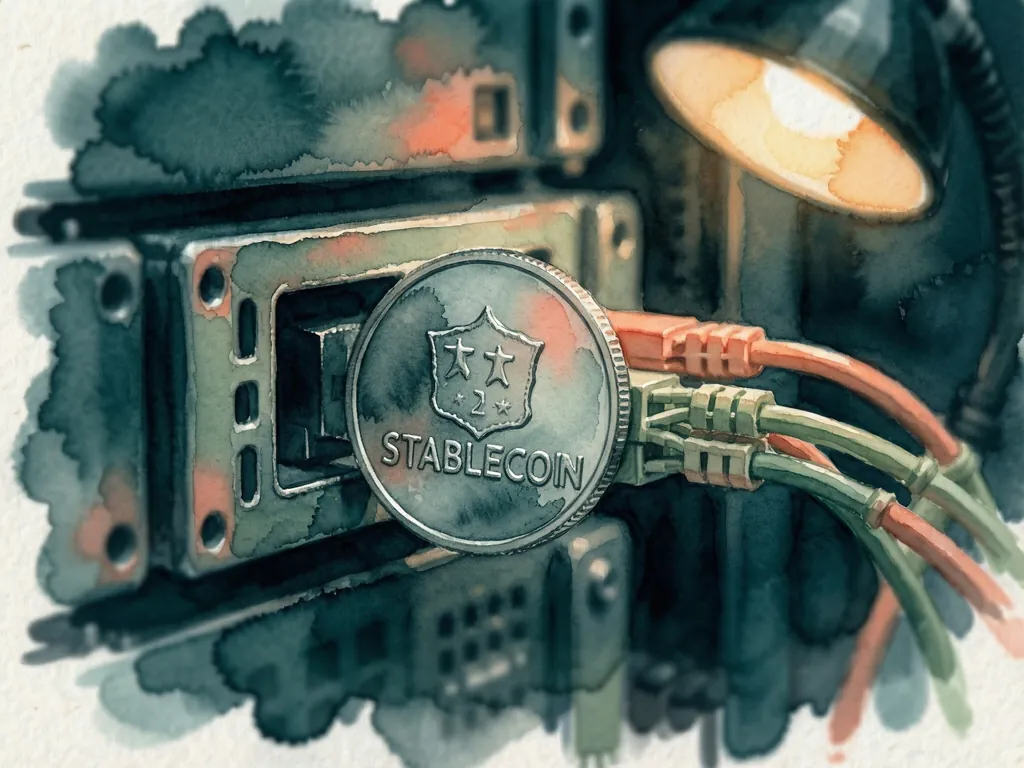
BlackRock reveals that AI can create a stable customer base in new ways. That's "machines" that spend money continuously without asking permission from humans.
The world's largest money managers believe that more autonomous AI systems will be able to purchase data, access software and provide processing resources on their own, potentially adding new business opportunities for digital assets beyond human trading and payments.
This trend is at the heart of a new edition of BlackRock 's report titled The Machine-Native Economy, which indicates that AI could eventually replace whoever initiated an economic activity. Rather than humans deciding to pay for each task, software can perform thousands of small tasks in order to accomplish one task.
Stablecoin entered the market with a turnover of more than US$300 billion and an adjusted transaction volume of approximately $11.2 trillion by 2025, according to data from BlackRock . The company calculated that such volumes would grow at an average rate of 80% per year between 2020-2025 compared to about 8.5% for the U.S. ACH network.
However, ACH still generated about $93 trillion last year, reflecting that stablecoin is far from the largest traditional payment channel. BlackRock also cautioned against comparing stablecoin activity to Visa and Mastercard directly because each network measures business differently.
But the change that may be bigger is in business behaviour rather than existing business volume.
An AI agent that is searching for or processing information may even charge a fee for each API call. These transactions can be worth as little as a few cents and take place over 24 hours before the payment method differs markedly from credit cards or banks, which are designed for human customers.
That's an opportunity for stablecoin because the software can be held in a programmable wallet and transactions can be made without having to have someone approve it every time.
Stablecoin may win the "Wallet of Machines" before blockchain wins in economics
Payment companies are already competing over how these businesses will run.
Protocol x402 of Coinbase Use location HTTP 402 "Payment Required" of the website to provide service charge before submitting data or resources Agent ask for API Get payment advice Call USDC and receive services without having a human click checkout
Stripe and Tempo are developing Machine Payments protocols that allow payments to be made through stablecoins or traditional payment methods, while the Agentic Commerce Protocol of Strip with OpenAI connects agents AI into their store systems.
This multi-stakeholder approach makes it unreasonable to assume that the machinery business will move into an automated chain.
Traditional payment networks can accommodate independent software, especially where agents do business with existing businesses and consumers while stablecoins have an advantage at the point where payments are very small, frequent or native to the software.
There's also a second component, which is that the value of these payments will eventually accumulate.
If an agent builds a stablecoin business on Ethereum more, the increased usage may increase demand for block space and services validator ETH is used in network charging and stacking systems which are one way that higher business activity affects real assets
But the growth of a business with high demand does not necessarily increase simultaneously
BlackRock notes that the value captured by crypto assets is based on a fee structure, stake economics and gas-sponsorship model. The network can process large volumes while charging very low fees, and the application also protects users and agents from having to hold gas for themselves.
Arc of Circle is another model, a blockchain-based payment system that uses USDC as its gas asset network, meaning the increased activity can take on a stablecoin role without passing through the same mechanism to other networks like ETH .
For investors, this distinction may be more important as the payments of expansion machines; stablecoin issuers may have business demands while networks that process these transfers compete separately to convert higher throughput into economic value.
AI processing power can make customer machines much larger
BlackRock expects that this same charging architecture will reach one of the largest expenses for AI, which is processing power.
Accumulated investment in AI infrastructure between 2025 and 2030 could exceed $5 trillion, while Bloomberg estimates that BlackRock , a reported net revenue of $ Amazon Web Services , the Intelligent Cloud businesses of Microsoft and Google Cloud will be around $1.1 trillion by 2030.
That would create a large resource market for more independent agents to travel.
Agents can compare processors by price, hardware location, latency or performance. They are purchasing the processing for a specific task and automatically charging fees. Charges may be generated as reports of usage or they may be model reports.
AI inference will become a machine-to-machine business cycle that repeats itself: software searches, computes, buys, uses and pays without human intervention at each step
BlackRock believes that larger financial markets may be formed around such activities.
While futures markets may help buyers and sellers hedge the volatility of capital costs, such a market requires standards that take into account differences in chip price, energy location and efficiency.
This part of the issue is still largely predictable, as payment agent activity is in its infancy and traditional money companies are building their own infrastructure for automated trading alongside crypto firms.
The closest competition is "Wallets of Machines"
Stablecoin developers wanted their tokens to be an asset-based form of software, payment protocols had to become a standard that agents used and paid for Ethereum assets, and blockchain competitors faced the more difficult task of converting high throughput stablecoins into demand for their economic assets.
While traditional payment networks have an incentive to keep these activities on their original currencies, there's still a lot of uncertainty.
As AI systems gain more spending power, these competing infrastructures will have to fight for customers who never sleep, do business thousands of times in a row and may be attracted by the price, speed of payments and ability to program more than any payment network behind that payment.
This article was originally published on CryptoSlate in BlackRock sees a new $5 trillionAI trade emerging for stablecoins
Related articles



Comments (0)